Dementia friendly home modifications: where to start
If someone you love is living with dementia and wants to stay in their own home, you have probably wondered which changes are worth making.
New Australian research gives a clear answer. The simple, low cost changes do the most good. Ramps and level entries. Rails. A safer bathroom. Better lighting. Clear paths through the house.
You do not need to change everything at once. In fact, the evidence says you should not.
If you would like to talk it through with a local builder, get in touch with JPS Services. We are a Canberra team and we are happy to have a look and give you honest advice.
The short version
- The strongest evidence is for small, practical changes, not big technology
- The highest risk areas are entries and steps, bathrooms, stairs, hallways and lighting
- Changes work best when they are made gradually, not all in one go
- Work that still looks like a home, rather than a hospital, is more likely to be accepted and used
- Starting before a fall is better than starting after one
- Aged care and NDIS funding can help pay for this work
What the research actually says
In June 2026, the Home Modification Information Clearinghouse at UNSW Sydney published a review of the evidence on helping people with dementia stay at home. It was written by Sima Alizadeh. The team looked at 35 publications in full and included 23 studies.
The clearest finding was this. Low cost home modifications were linked to fewer falls and homes that were easier to use. The examples given were bathroom changes, grab rails, better lighting and safer movement around the house.
Smart home technology looked promising, but the results were mixed. It depended heavily on whether people could actually use it and whether they had support.
The review also named the areas of the home where changes make the biggest difference. Bathrooms and toilets. Stairs and thresholds. Poorly lit hallways and walkways. Cluttered paths.
That list is worth reading twice, because it tells you where to spend your money first.
Start at the front door
Entries and steps sit right at the top of that list, alongside bathrooms. They are also the part of the house most people forget about.
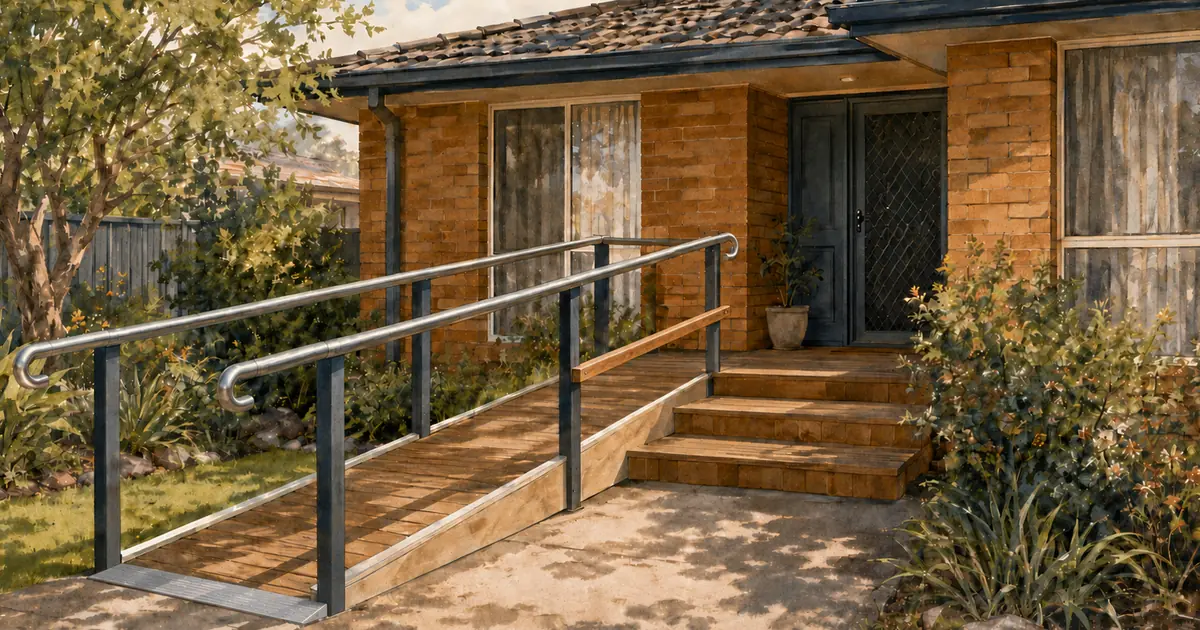
The review lists ramps, handrails, removing steps and safer stairs as one of the main groups of changes that help.
Why entries matter so much
The front door is where the house meets the weather. In Canberra that means frost, wet leaves in autumn and low winter sun in your eyes. A step that is easy in January can be a real hazard in July.
It is also the part of the home people use every single day, often while carrying something, and often in a hurry.
Ramp, or something smaller?
There is more than one way to solve a step, and the right answer depends on the house.
- A threshold ramp deals with a small lip, like a doorway or a sliding door track. It is a modest change and often the first thing to try.
- A modular ramp is built from sections. It can be adjusted or taken away later if things change, which suits a rental or a home where needs are still shifting.
- A permanent ramp in timber or concrete suits a home where the change is long term and there is room to build it properly.
- Removing the step altogether is sometimes the neatest answer, particularly at a back door or a garage entry.
See the ramps we build on our wheelchair and disability ramps page.
Which one is right is a question for your occupational therapist and your builder together. The OT looks at how the person moves. The builder looks at what the house will allow. Both matter.
Making a ramp easy to see and use
A ramp is not only about the slope. For someone living with dementia, being able to see the ramp clearly is just as important.
The UNSW review talks about improving contrast and reducing glare, and about giving people clear visual cues. In practice, for an entry, that means thinking about:
- Whether the edges of the ramp stand out from the surface around them
- Whether handrails are easy to pick out against the wall or the garden behind them
- Whether the surface is busy or patterned, or calm and even
- Whether there is glare from a wet or polished surface in the afternoon sun
- Whether the approach is lit well enough to use after dark
We are happy to talk through entry and access work on any Canberra home. Our home modification services page covers the range of work we do.
Rails, inside and out
Grab rails come up again and again in the research as one of the changes with the strongest evidence behind them. They are quick to install and they work.
The things that matter most are position and fixing. A rail has to be where the person actually reaches for it, and it has to be fixed into something solid. A rail that moves is worse than no rail at all, because people come to rely on it.
Outside rails matter too. A rail beside the front steps, or alongside a ramp, gives people something to steady themselves with in wet or frosty weather.
Our guide on how to get grab rails installed in Canberra explains the process and the funding side.
The bathroom
Bathrooms and toilets sit at the top of the high risk list in the review, and this matches what we see in homes across Canberra.
The changes that come up most often are step free showers, grab rails, non slip flooring and better, more even lighting.
A shower hob is a common problem. That raised lip at the shower entry is easy to step over until it is not. Sometimes a small ramp solves it. Sometimes the hob needs to come out. It depends on the bathroom.
If you are at the earlier stage, our bathroom safety modifications guide covers the simpler options. If the layout itself is the barrier, our guide to accessible bathroom renovation in Canberra explains what a full rebuild involves.
Lighting and clear paths
This is the cheapest item on the list and often the most overlooked.
The review points to poorly lit walkways and cluttered paths as a repeated source of trouble. It also talks about reducing glare and avoiding layouts that confuse people.
Practical things worth looking at:
- Even lighting along hallways, with no dark patches between lights
- Good light at the top and bottom of any steps
- A clear, unobstructed path between the bedroom, the bathroom and the kitchen
- Reducing glare from shiny floors and unshaded windows
Much of this is not building work at all. Sometimes it is moving a piece of furniture.
Keeping the home feeling like a home
This is the part of the review we found most interesting, and it is the part we agree with most strongly.
The researchers describe a real tension. Safety changes are necessary, but familiarity is what helps someone feel settled and know where they are. Families often put off changes because they do not want the house to stop feeling like theirs.
The evidence favoured changes that were gradual, that looked domestic rather than institutional, and that kept the look and feel of the home consistent.
We think that is exactly right. There is a big difference between a rail that looks like hospital equipment and one that looks like it belongs. Between a ramp that dominates the front garden and one that sits in with the house.
It is the same work. It just takes a bit more thought.
Why starting early beats waiting
The review is blunt about this one.
It describes home changes as something that happens over time, not once. Needs change, so the home needs to change with them.
It also found that changes are too often triggered by something going wrong, usually a fall. When that happens, the work gets rushed. Rushed work is more disruptive, and it is more likely to leave the home feeling unfamiliar at exactly the moment someone needs it to feel familiar.
The review recommends assessing the home early and planning ahead, rather than reacting to a crisis.
There is good reason to take that seriously. The Australian Institute of Health and Welfare reports that falls were the leading cause of injury hospitalisations in 2024 to 2025, and the leading cause of injury deaths in 2023 to 2024. Home was the most commonly recorded place where fall injuries happened.
Who this affects in Canberra
Dementia Australia estimates that in 2026 around 6,300 people are living with all forms of dementia in the ACT. That figure is projected to reach around 12,300 by 2054.
Nationally, Dementia Australia estimates that 2 in 3 people with dementia are living in the community rather than in residential care.
So this is not a small group, and most of them are at home.
How this work gets funded
You may not need to pay for all of this yourself.
Aged care
For people aged 65 and over, the Support at Home program includes a separate Assistive Technology and Home Modifications scheme. Home modifications have three funding tiers: low up to $513, medium up to $2,052 and high up to $15,390. These amounts are indexed on 1 July each year, so it is worth checking the current figures on the My Aged Care or health.gov.au websites.
Two things are worth knowing about the high tier. It can only be used once in a person's lifetime. And the budget runs for 12 months, though it can be extended by another 12 months for complex work.
That once in a lifetime rule is a good reason to plan the work properly rather than piece it together.
Home modifications listed under the scheme include grab rails, internal and external handrails, ramps, bathroom redesign and widening doorways.
A My Aged Care assessment is the starting point. You can reach My Aged Care on 1800 200 422.
NDIS
For NDIS participants, home modifications are funded through the capital supports budget and need an occupational therapist assessment. Our NDIS home modifications guide explains how that works.
Private
Some families prefer to organise the work themselves without going through a funding process. That is completely fine, and an OT assessment is still worth getting so the layout is right.
Our funding guide walks through every pathway.
If the home is rented
The UNSW review notes that tenancy rules and housing arrangements can make it harder for renters to get the changes they need.
In the ACT, tenants need to ask the landlord in writing before making changes to a property. For some minor and safety modifications, a landlord who wants to say no must apply to the ACT tribunal for permission to refuse. The rules are worth checking before you plan anything. Access Canberra can point you in the right direction.
Common questions
Do I need an occupational therapist first?
For aged care or NDIS funded work, yes. For private work, no, but we would still recommend one. An OT sees things about how a person moves that a builder will not.
Should we do everything at once?
The evidence says no. Gradual, staged changes work better, and they are easier to live with. Start with the highest risk areas, which for most homes means the entry and the bathroom.
Will the work make the house look clinical?
Not if it is planned properly. This is something we care about and something we will talk to you about before we start.
Do you work outside Canberra?
Yes. We cover Canberra and the surrounding region, including Queanbeyan, Yass, Murrumbateman and Bungendore.
Are you licensed?
Yes. Our builder William holds a current builder licence in both the ACT and NSW, with 30 years of experience.
For occupational therapists and case managers
The UNSW review makes a point that is worth passing on. It found that professional recommendations are one of the strongest things that actually get modifications done, and that many households adapt reactively without any guidance at all.
If you are assessing a client and want a builder's view on what a house will physically allow before you finalise a recommendation, we are glad to help. Our allied health referral page explains how we work with referrers.
Talk to us
If someone in your family is living with dementia and you are wondering where to start, start with a conversation. There is no cost and no obligation.
You can see examples of our work on our recent projects page, and our how it works page explains our process in plain English.
When you are ready, get in touch with JPS Services. We will come and have a look, talk it through properly, and stop for a cuppa if you would like one.
Reference
Alizadeh, S. (2026). Evidence Based Practice Review: Ageing in Place with Dementia: Modifications and Design Innovations for the Home. 1st ed. Home Modification Information Clearinghouse, UNSW Sydney. DOI: 10.26288/gatz-bq24. Available at homemods.info